
If you feel like nutrition advice changes every week, you are not imagining it. One day eggs are “bad”, the next they are “fine”. Coffee is either a miracle or a menace. Social media rewards bold claims, and headlines rarely match what the research actually showed.
This guide will help you sort nutrition information you can trust from advice that is best ignored, so you can make calmer, evidence-led choices for your health.
Why nutrition information is so confusing
Nutrition is hard to study well. Unlike drug trials, researchers cannot easily control everything people eat for years, and people’s diets are tied to sleep, stress, income, medication, movement, and culture.
A few common reasons “new” nutrition advice appears contradictory:
- Most studies are observational (they notice patterns rather than prove cause and effect).
- Dietary reporting is imperfect (food diaries and questionnaires rely on memory and honesty).
- Headlines simplify nuanced findings to get clicks.
- Different goals need different advice (fat loss, cholesterol, menopause symptoms, IBS, cancer recovery support and athletic performance are not the same problem).
The good news is that there are reliable ways to judge what is likely to be true and useful.
A simple hierarchy: what evidence should carry the most weight?
Not all “evidence” is equal. If you only take one thing from this article, let it be this: a single study rarely proves anything in nutrition.
In general, these sources become more reliable as you move down the list:
- Expert consensus and guidelines based on multiple studies (for example, NHS guidance, NICE, or major medical and dietetic organisations).
- Systematic reviews and meta-analyses that assess the totality of evidence.
- Randomised controlled trials (RCTs), especially when well-designed and long enough to matter.
- Observational studies (useful for spotting patterns, but weaker for proving causation).
- Animal studies and lab studies (helpful for hypotheses, not direct “human advice”).
- Anecdotes and testimonials (interesting, but not proof).
For UK readers, a strong starting point for general healthy eating is the NHS Eatwell Guide. It is not perfect for every individual, but it is based on a broad evidence base and designed for population health.
What sources of nutrition information are generally trustworthy?
Use this as a quick reference when you are deciding whether to believe something you have read.
| Source type | Usually trustworthy when… | Watch out for… |
|---|---|---|
| NHS, NICE and other public health bodies | Advice is consistent, cautious, and evidence-based | Oversimplification for general populations, it may not address your specific condition |
| Registered Dietitians and qualified nutrition professionals | They explain the “why”, cite evidence, and tailor advice | Overconfident claims, selling quick fixes, fear-mongering |
| Peer-reviewed journals | You can check methods, sample size, and limitations | Paywalls, and you still need context and replication |
| Systematic reviews (e.g. Cochrane) | They assess multiple studies and quality | Reviews can be outdated, or conclusions can still be “uncertain” |
| Reputable health charities and academic institutions | They cite sources and update content | Some content is simplified, and may lag behind new evidence |
| Social media posts | Useful for ideas, recipes, motivation | Algorithms reward extreme claims, cherry-picked studies, and before/after photos |
If you want a dietitian’s perspective on misinformation patterns, the British Dietetic Association (BDA) is a reliable UK reference point.
A practical “trust check” you can do in 2 minutes
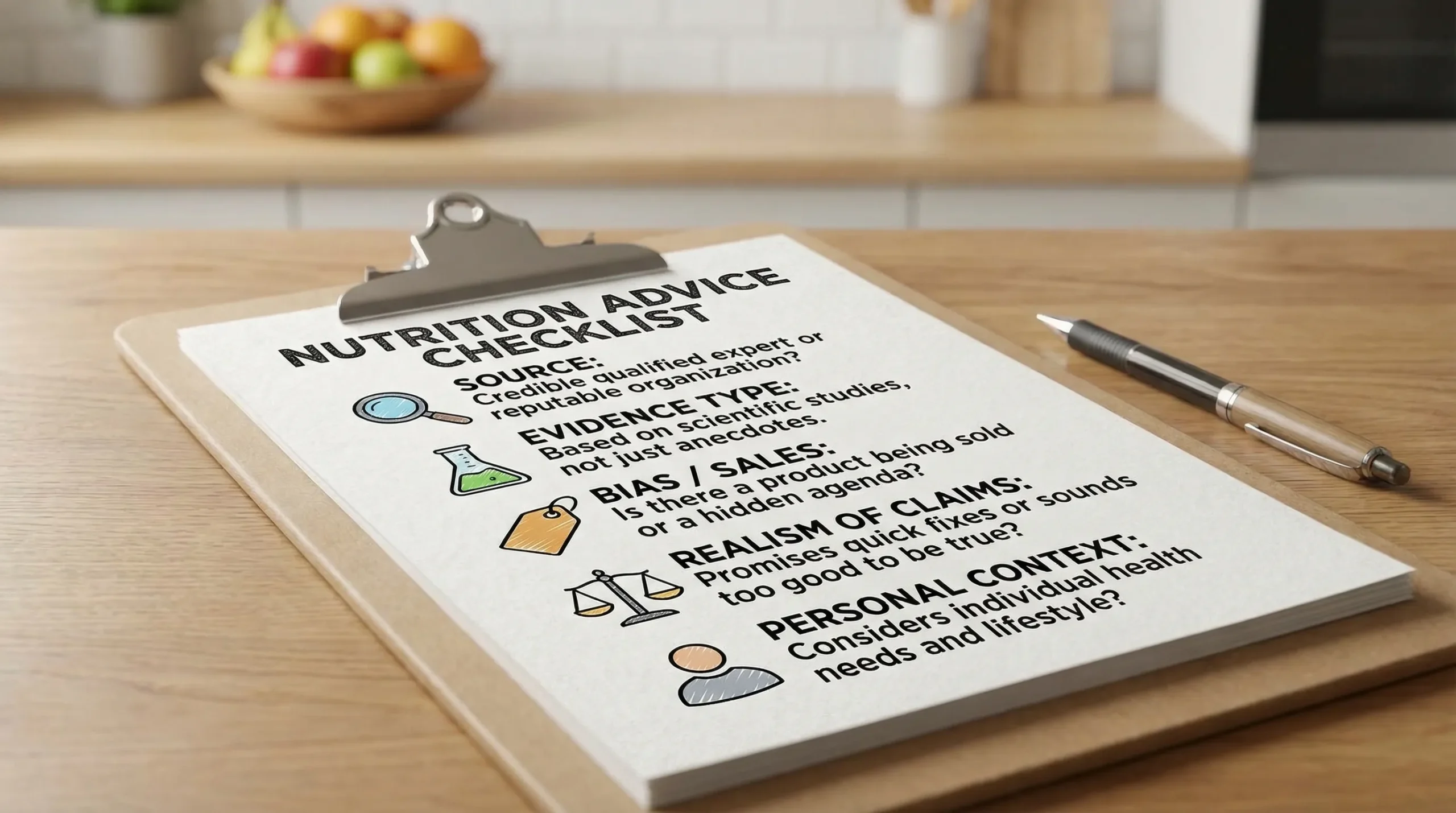
When you see a nutrition claim, run through these questions.
1) Who is making the claim, and what are they selling?
A person can be knowledgeable and still biased. If the post ends with “buy my detox tea”, “use my supplement code”, or “join my challenge”, treat the advice as marketing first and health guidance second.
2) Is it talking about outcomes that sound too good to be true?
Be wary of promises like:
- “Lose a stone in 2 weeks.”
- “Fix your hormones fast.”
- “Heal your gut in 7 days.”
- “Reverse disease with this one food.”
In real life, meaningful change tends to be less dramatic and more sustainable.
3) Does it use fear, shame, or moral language?
“Clean” vs “toxic”, “good” vs “bad”, “guilty pleasures”, and “you’re poisoning yourself” language is a red flag. It often pushes rigid rules that do not hold up long-term.
4) Does it cite evidence you can actually check?
A screenshot of a chart is not a citation. Look for:
- The study title or a link to it
- Who funded it
- Whether it was done in humans
- Whether it measured real outcomes (cholesterol, HbA1c, blood pressure) vs “markers” or opinions
5) Does it acknowledge individual differences and medical context?
Good nutrition information usually includes phrases like “this may not be suitable if…” and encourages personalised support if you have symptoms, medical conditions, or are taking medication.
How to read a nutrition headline without being misled
Many headlines are technically not “wrong”, but they are incomplete. Here are the most common tricks.
Correlation is not causation
If a study finds that people who eat more yoghurt have better health outcomes, yoghurt might not be the magic. Those people might also sleep more, smoke less, or have better access to healthcare.
Relative risk can sound scarier than absolute risk
“50% increased risk” sounds dramatic, but if the absolute risk rises from 2 in 1,000 to 3 in 1,000, the real-world change is small. Ask: “50% of what?”
Short studies cannot prove long-term effects
A 2-week dietary trial can show changes in appetite or blood sugar response, but it cannot prove long-term fat loss maintenance, heart health, or disease outcomes.
One study is a starting point, not a conclusion
It is normal for early findings to be overturned or softened when more evidence accumulates.
What to ignore: common nutrition myths and noisy trends
These topics come up repeatedly in clinic, and they are frequent sources of confusion.
1) Detoxes, “cleanse” teas, and extreme resets
Your liver, kidneys, gut, lungs and skin are already doing detox work all day. Most detox plans simply:
- Cut calories sharply (so you lose water and glycogen)
- Reduce fibre and protein (so you feel worse)
- Encourage expensive products that do very little
If you want to support normal detox pathways, focus on fundamentals: adequate protein, fibre-rich plants, hydration, and regular bowel movements. If you have persistent symptoms (fatigue, bloating, constipation, skin issues), that is a sign to investigate root causes, not “cleanse harder”.
2) “Hormone balancing” diets that ban lots of foods
Hormones are influenced by energy intake, body fat, sleep, stress, insulin sensitivity, thyroid health, gut function, alcohol, and more.
A plan that blames everything on one food group (often carbs, gluten, dairy, or seed oils) is usually oversimplified. Some people do feel better with targeted changes, but blanket bans without a clear reason can create deficiencies and anxiety around food.
3) “One supplement fixes it” claims
Supplements can be helpful, but they are not magic. Quality, dose, form, interactions, and your individual needs matter.
If you are considering supplements, prioritise:
- A clear goal (for example, iron deficiency confirmed by blood test, or supporting dietary gaps)
- Evidence-based dosing and duration
- Safety and medication interactions
In the UK and EU, health claims are regulated, and you can search approved claims via the EFSA register. If a product claims to “cure” or “treat” disease, be cautious.
If you would like a practitioner-led overview of supplement quality considerations, see my page on recommended supplements (with the important caveat that supplements should be chosen based on your personal health picture).
4) Gut health advice that jumps straight to restriction
Gut symptoms are common, and restrictive plans are everywhere online. For IBS-type symptoms, approaches like Low FODMAP can be evidence-based when done correctly, but they are not meant to be permanent.
If you are restricting more and more foods, symptoms are not improving, or your diet is becoming stressful, that is a sign you may need a structured plan and support. (My Low FODMAP resources emphasise the phased approach and reintroduction, for example in this Low FODMAP guide.)
5) “Calories do not matter at all” vs “only calories matter”
Both extremes are unhelpful.
- For weight change, energy balance matters.
- For appetite, cravings, mood, menopause symptoms, digestion, cholesterol, and long-term adherence, food quality and behaviour matter enormously.
Most people do best when they stop chasing hacks and start building meals that keep blood sugar steadier and hunger predictable: protein, fibre, colourful plants, and healthy fats.
What to trust: nutrition principles that rarely change
While details evolve, several foundations are consistently supported.
Build meals around protein and fibre
This helps satiety, supports muscle maintenance (especially important in perimenopause and menopause), and improves metabolic health.
Eat a variety of plants
Plant diversity supports micronutrients and gut microbiome diversity. You do not need perfection, you need consistency.
Favour minimally processed foods most of the time
Ultra-processed foods are easy to overeat and often displace more nourishing choices. This does not mean you must avoid convenience food, it means be intentional with it.
Look after the “non-food” levers
Sleep, stress, alcohol intake, movement, and strength training can dramatically change how your body responds to a diet.
Personalisation beats generic rules
Two people can eat the same “healthy” diet and have very different results depending on symptoms, life stage, medications, gut function, and health history.
When you should get personalised support
Online nutrition information is best for general education. It is not a substitute for individual assessment.
Consider professional support if:
- You have ongoing digestive symptoms, fatigue, headaches, or unexplained weight change
- You are in perimenopause or menopause and symptoms are affecting quality of life
- You are managing cholesterol, blood sugar, blood pressure, or liver health
- You are recovering from cancer treatment and want safe, supportive nutrition strategies
- You feel stuck in cycles of restriction and rebound eating
It is also important to speak with your GP promptly if you have red-flag symptoms (unintentional weight loss, blood in stool, persistent vomiting, difficulty swallowing, or severe fatigue), or if you suspect nutrient deficiencies.
A calm way to use nutrition information day-to-day
Instead of trying to follow every new trend, use a simple decision filter:
- Is this advice safe? (especially if pregnant, breastfeeding, on medication, or managing a condition)
- Is it realistic for me for 3 months? If not, it is probably not the right strategy.
- Does it improve how I feel and function? Energy, digestion, sleep, cravings, mood, strength
- Can I measure progress sensibly? Symptoms, waist measurement, strength, blood markers with your GP
If you want to explore a medically-led perspective on weight loss medications alongside sustainable nutrition habits, you may also find my article on GLP-1 drugs and how they work helpful.
Frequently Asked Questions
What is the most reliable source of nutrition information in the UK? NHS guidance is a strong starting point for general advice. For personalised needs, work with a qualified professional who can adapt evidence to your health history, symptoms, and goals.
How do I know if a nutritionist is properly qualified? Look for clear training credentials, professional membership, and insurance, plus a practitioner who stays within scope, uses evidence, and encourages appropriate medical support when needed.
Are supplements a waste of money? Not always. Supplements can be useful when there is a demonstrated need (for example, a dietary gap or deficiency), but they are rarely a substitute for diet and lifestyle foundations. Quality and suitability matter.
Is it true that one food can reduce inflammation or “balance hormones”? Single foods can contribute beneficial nutrients, but hormones and inflammation are influenced by overall dietary pattern, sleep, stress, body composition, movement, and medical factors. Be cautious of single-solution claims.
Should I cut out gluten or dairy to be healthier? Only if there is a clear reason. Some people feel better with targeted changes, but unnecessary restriction can reduce diet quality and make eating stressful. If you suspect intolerance, get guidance on a structured approach.
Ready for advice you can trust (and apply)?
If you are tired of conflicting nutrition information and want a clear plan built around your body, your symptoms, and your life, I can help.
Tracey Warren Nutrition offers personalised naturopathic nutrition support for weight loss, menopause, digestive health, cholesterol management and cancer recovery support. Sessions are available in Cheshire and nationwide via video call.
You can book a free 15-minute consultation via Tracey Warren Nutrition to talk through your goals and the next best steps.